

A practical guide for London SMEs, from an accredited Microsoft Solutions Partner for Modern Work
We have lost count with the number of times we have sat down with a London business owner who’s paying for the wrong Microsoft 365 licence. Sometimes they’re overpaying, for example a five-person consultancy on Business Premium because “that’s what the last IT company set up.” Alternatively some are underpaying in a way that’s quietly expensive, for example a firm handling client financial data on Business Basic, with no device management, no advanced threat protection, and no idea that’s the situation they’re in.
Microsoft doesn’t make this an easy decision. There are three core business tiers, each with a “with Teams” and “without Teams” variant, Copilot add-ons on top of all of them, and a July 2026 pricing update that’s changed the maths on which tier actually represents value. Add the fact that most businesses don’t need or want every employee on the same plan, and it’s easy to see why licensing decisions get made once at setup and never revisited.
This isn’t a sales pitch for the most expensive option. It’s the framework we use to match licences to actual business needs; because the right answer is completely different for a five-person creative studio in Shoreditch than it is for a 40-person accountancy in the City.
The three core plans, in plain terms
All three plans support up to 300 users, include 1 TB of OneDrive storage per user, and come with Exchange email, Teams, and SharePoint as standard. Where they diverge is desktop apps and security. Prices below are Microsoft’s current UK list prices, per user/month, paid annually, excluding VAT.
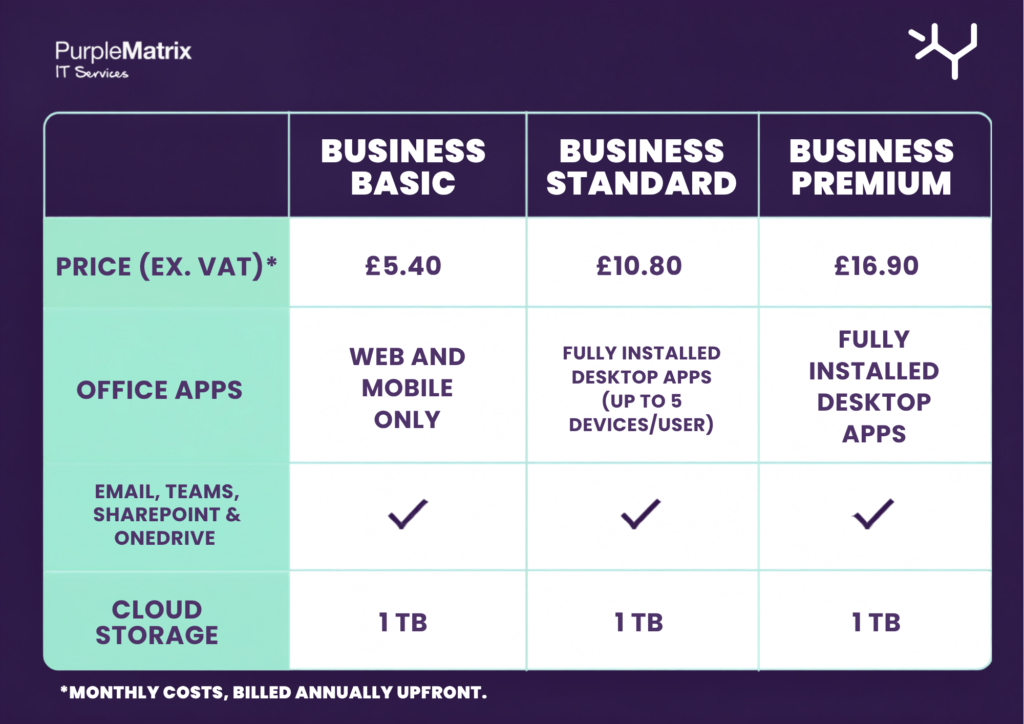
The headline shift since Microsoft’s July 2026 price update: Business Premium held its price while Basic and Standard both went up. The gap between Standard and Premium has narrowed to roughly £6/user/month, for a real jump in security capability. That changes the calculus for a lot of SMEs who’ve historically defaulted to Standard.
Copilot is available as an add-on across all three tiers for roughly £18–24.60/user/month depending on plan, bundling in AI-assisted drafting, research, and data analysis inside Word, Excel, PowerPoint, Outlook, and Teams.
Matching the plan to your business, not the other way round.
Here’s where most licensing decisions go wrong: businesses pick a tier for the whole company, rather than asking what each role actually needs.
The lean creative or marketing studio (5–15 people, mostly browser-based, no client financial data) If your team lives in Figma, Canva, and Google-adjacent workflows and only touches Office apps occasionally, Business Basic covers email, Teams, and file storage without paying for desktop apps nobody installs. Just be honest about whether that’s really true. The moment someone needs to build a complex pitch deck offline on the train to a client meeting, Basic starts to chafe.
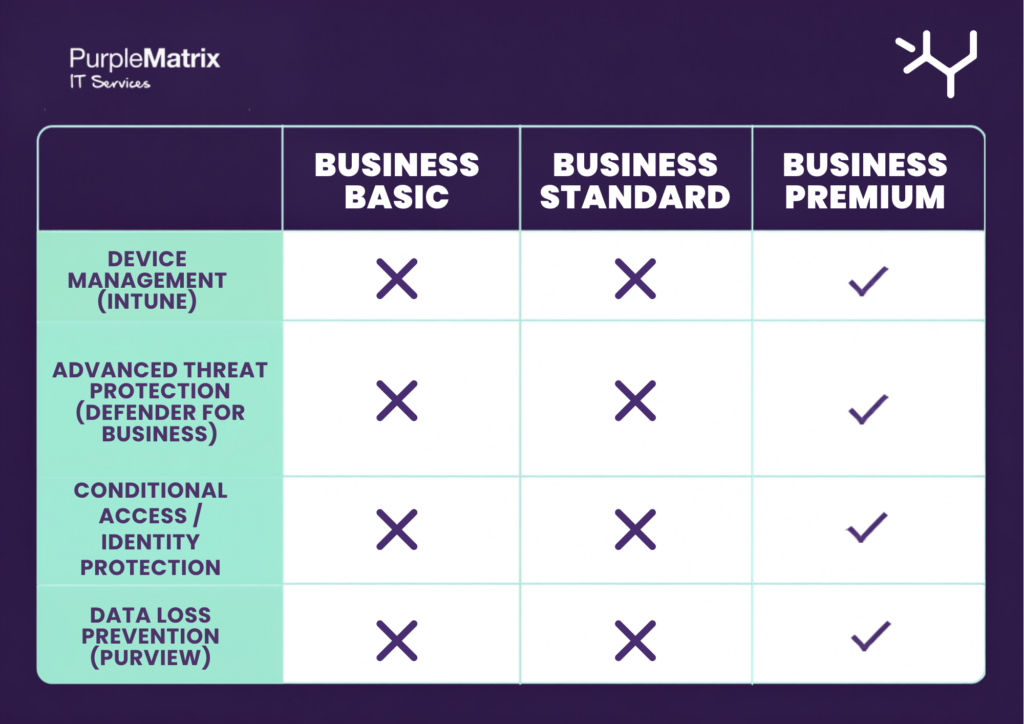
The professional services firm: accountants, solicitors, consultants (10–50 people, handles client data) This is the group we push hardest towards Business Premium, and it’s not really a discretionary call anymore. If you’re handling client financial records, case files, or personal data, you’re sitting on regulatory exposure (UK GDPR, and increasingly cyber insurance underwriters ask direct questions about MFA enforcement and endpoint protection) that Basic and Standard simply don’t cover. Defender for Business and Intune aren’t nice-to-haves here. They’re the difference between a phishing click being a non-event and being a breach notification to the ICO.
The fast-growing startup (15–40 people, hybrid/remote) Growth-stage teams tend to have the widest spread of devices: personal laptops, a mix of Mac and Windows, people joining from previous jobs with old habits. Business Premium’s conditional access and Intune device management let you enforce security policy without owning every device outright, which matters when you can’t mandate company hardware for budget reasons. Standard is tempting on price, but the device sprawl at this stage is exactly the risk profile Premium is built for.
The established SME with a mixed team (50–150 people) This is where “one licence for everyone” gets genuinely expensive and genuinely wasteful. The right answer is almost always a blend: Premium for anyone touching client data, finance, or HR; Standard for general staff who need desktop apps but handle lower-risk information; Basic or F3 for anyone who’s primarily communicating rather than producing documents. Microsoft explicitly supports mixing tiers within one tenant with no minimum seat count per plan. There is no penalty for doing this properly.
The mistake we see most often.
It’s not the wrong tier, it’s the static tier. A licensing mix that made sense at 12 people rarely still fits at 45. People change roles, an office-based team goes hybrid, a firm starts handling a new category of sensitive client data and nobody revisits what that means for security licensing. We’d recommend treating your Microsoft 365 licence mix the way you’d treat an insurance policy: reviewed at least annually, not set once and forgotten.
The second most common mistake is treating Business Premium’s security features as something to “get around to configuring” after purchase. Paying for Intune and Defender for Business without actually enrolling devices and setting conditional access policies is the licensing equivalent of buying a fire extinguisher and leaving it in the box.
Getting the decision right.
There’s no universally “best” Microsoft 365 licence, there is just the best one that matches what your people do and what your business is exposed to. For most London SMEs handling any client, financial, or personal data, that increasingly means Business Premium as the default, with Basic or F3 reserved deliberately for genuinely low-risk, low-usage roles.
As a Microsoft Solutions Partner accredited in Modern Work, this is the kind of assessment we run for clients before recommending anything: mapping actual roles and data sensitivity to the right mix of licences, rather than starting from a price list. If you’re not sure whether your current setup still fits your business, it’s worth a proper review rather than a guess.
Get in touch if you’d like us to run a free licensing and security review for your business.