
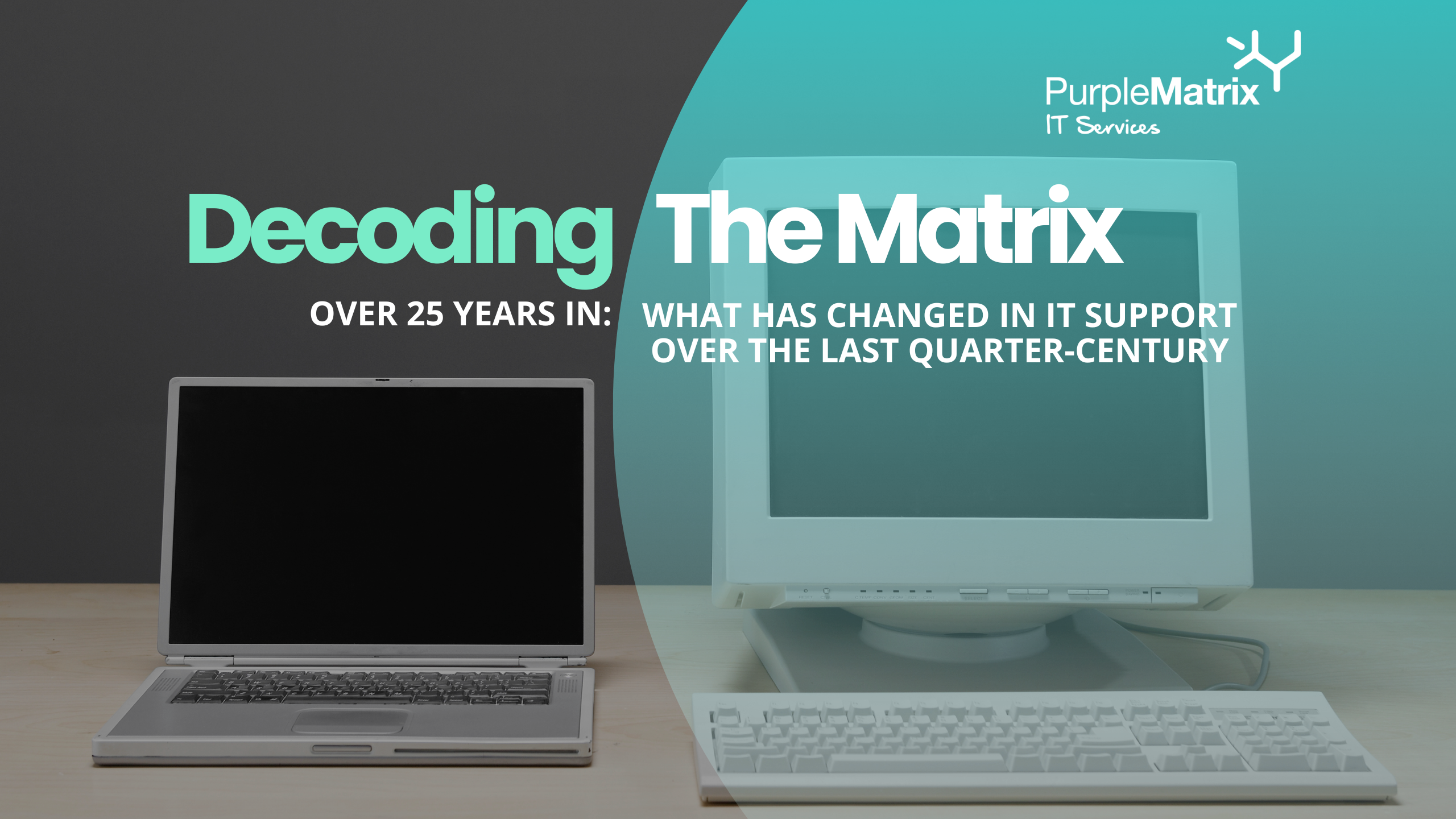
When our company opened its doors in 2000, “the cloud” meant weather, a “server” lived in a locked closet down the hall, and a good firewall was, more often than not, a piece of hardware you could actually point to. Twenty-five years later, we’re still here: but almost nothing else about IT looks the same.
We thought it was worth taking stock. Not just as a trip down memory lane, but because understanding how far the industry has come says a lot about what it takes to stay relevant in it. Here’s what’s changed, and what it’s meant for the businesses we support.
From Server Rooms to the Cloud
In 2000, “infrastructure” meant physical machines. Every business with serious IT needs had a server room (or at least a server closet), and every new employee, every new application, every bit of growth meant more hardware to buy, rack, and maintain. Backups ran to tape drives. Disaster recovery meant driving a box of tapes to an offsite location.
Today, most of that has moved to the cloud. Platforms like AWS, Microsoft Azure, and Google Cloud turned infrastructure into something you rent instead of own. Businesses that once needed a capital budget for a server refresh now scale up or down with a few clicks. It’s cheaper, faster, and more resilient, but it also means IT support looks completely different than it did in 2000. Managing a cloud environment well requires a different skill set than managing a server room ever did.
The Rise of the Internet
In 2000, dial-up was still common in plenty of businesses, and broadband was the exciting new thing. Email was the primary digital communication tool, and most companies’ “online presence” was a static website that rarely changed.
The internet has obviously become the backbone of how businesses operate, but it’s also become the primary attack surface. Cybersecurity in 2000 largely meant antivirus software and a firewall. Today it means multi-factor authentication, endpoint detection and response, security awareness training, incident response planning, and constant vigilance against threats that didn’t exist a decade ago, let alone 25 years ago. Now, organisations face fears of ransomware-as-a-service, business email compromise, supply chain attacks, and increasingly, AI-generated phishing that’s nearly indistinguishable from the real thing.
This is probably the single biggest shift in what it means to run IT for a business: security isn’t a feature anymore. It’s the foundation everything else sits on.
Mobile, Remote, and Everywhere
Twenty-five years ago, “work” happened at a desk, on a desktop computer, connected to a wired network. The idea of doing real business work from a phone was science fiction.
The smartphone changed that, and the pandemic finished the job. Remote and hybrid work are now the norm rather than the exception for a huge share of businesses. IT support used to mean walking down the hall to someone’s desk. Now it means securing and supporting a workforce that could be logging in from a home office, a coffee shop, or an airport. That shift alone has reshaped everything from network design to help desk operations.
From Reactive Fixes to Managed Services
In 2000, IT support was mostly reactive: something breaks, you call someone, they come fix it. That “break-fix” model was the norm across the industry.
The managed services model: proactive monitoring, regular maintenance, predictable flat-rate pricing, didn’t really take hold until well into the 2000s and 2010s. Instead of profiting when things went wrong, MSPs started aligning their success with keeping things running smoothly in the first place, which represented a fundamental shift in philosophy. That’s a better deal for everyone, and it’s the model we’ve built our business around for a reason.
Automation and Artificial Intelligence
If the last five years have taught the industry anything, it’s that the pace of change is still accelerating, not slowing down. AI-powered tools are now built into everything from threat detection to help desk ticketing to network monitoring, catching issues and anomalies faster than any human team could on their own. Automation has taken over huge swaths of routine IT work, freeing up technicians to focus on strategy and problem-solving instead of repetitive tasks.
It’s a genuinely exciting shift, but it also means the businesses that thrive are the ones working with an IT partner who can actually keep up with the tools, not just bolt on the latest buzzword.
Why 25 Years Actually Matters
Here’s the thing about an industry that changes this fast: a lot of companies don’t make it through the shifts. The provider that was great at managing on-prem servers in 2005 might not have made the leap to cloud infrastructure. The team that nailed break-fix support might never have adapted to proactive managed services. The MSP that mastered network security in 2010 has had to relearn large parts of that discipline three or four times since.
Staying in business, and staying good at this business, through five distinct eras of IT isn’t an accident. It takes a genuine commitment to continuous learning, a willingness to rebuild processes and retrain teams as the ground shifts, and a focus on outcomes for clients rather than attachment to any one way of doing things.
We’ve spent over 25 years doing exactly that. Every shift on this list: cloud, cybersecurity, mobile, managed services and AI, is one we’ve lived through with our clients, adapting our approach each time so their technology never falls behind, even as the target keeps moving.
The next 25 years will bring changes we can’t fully predict either. But if there’s one thing our history tells us, it’s that we’ll be ready for them. And we’ll make sure our clients are too.
Want to talk about where your IT strategy stands today? Contact us to see how 25 years of experience can work for your business.