

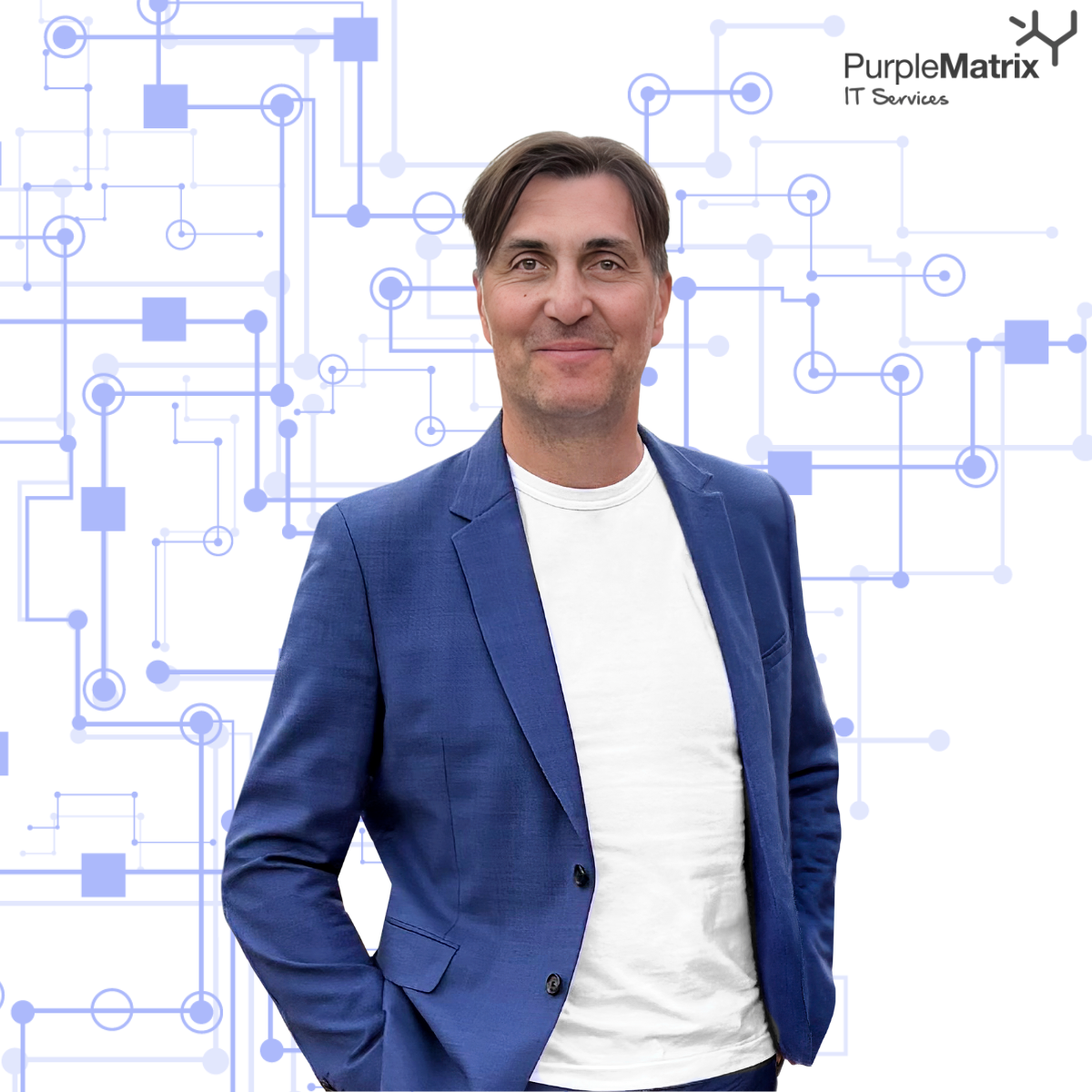
26 years ago, Adis Piric and Dylan Popovic started Purple Matrix from a living room, with a belief that businesses deserved better IT support. Over a quarter of a century later, that same philosophy still drives everything we do.
We sat down with our Managing Director & Co-Founder to talk about how the industry has changed, what’s stayed the same, and what he’s most proud of. Keep reading to learn more.
What made you start purple matrix in 2000, and what problem were you trying to solve?
“When Dylan and I founded Purple Matrix in 2000, we weren’t trying to build the biggest IT company there is, we were just trying to solve a problem we could see every day.
We’d both spent a few years working in IT and noticed that smaller businesses were being overlooked. Companies with just a handful of employees were too small to attract the attention of the larger IT providers, yet their technology needs had already outgrown the local “we fix computers” shop. They deserved the same level of professional advice and support as larger organisations, but very few providers were interested in serving them.
We were also at the perfect stage of life to take a chance. We were young, had very few financial commitments and, looking back, probably just enough optimism (read foolishness) not to realise how difficult starting a business would be. We lived frugally, relied on credit cards at times and simply believed that if we worked hard enough, we’d make it succeed. Back then, operating from my living room, we often used to cite the famous line from the ‘Fields of Dreams’ saying ‘if you build it, they will come’.
We certainly didn’t have all the answers, and we learned plenty along the way. What we did have was a genuine commitment to looking after our clients. We believed that if we built trust, delivered exceptional service and always did the right thing, the business would grow through reputation rather than sales.
That’s exactly what happened. As our clients grew, we grew with them. Today, our focus is on supporting established businesses of around 30 to 150 employees, but the philosophy hasn’t changed. We still believe every client deserves honest advice, exceptional service and a long-term technology partner they can trust.
Looking back, I’m proud that many of those early clients are still with us today, and others continue to pick up the phone whenever they need advice. That says more about our business than any growth statistic ever could.”
What was the IT industry like when you founded the company and what’s changed the most since then?
“The first thing that comes to mind is just how different the industry felt back in 2000. IT was driven more by enthusiasm than structure. There were far fewer standards, regulations or established best practices, and from a Managed Service Provider’s perspective, the market was nowhere near as crowded as it is today.
Supporting clients was also a very different experience. Remote support was limited to connecting to a server over a 54kbps modem, so most issues meant travelling to the client’s office. End-user devices weren’t really accessible remotely for several more years. Because of that, being local wasn’t just an advantage, it was essential if you wanted to deliver on your service commitments.
In many ways, that kept the industry honest! You couldn’t hide behind a slick website or clever marketing because your reputation depended on turning up and solving problems. It was much harder for ‘cowboys’ to make bold promises without the people, expertise and local presence to back them up.
Personally, the biggest shift has been my understanding of cybersecurity. When I started, I was probably too young and optimistic to imagine that every business could become a target for cybercriminals. Experience has taught me otherwise. Today, we approach every client environment with security at the forefront because the threat landscape has changed beyond recognition.”
What is the one thing about good IT support that hasn’t changed in 25 years, despite all the technology changing around it?
“It wouldn’t be unfair to say that few industries evolve as rapidly as IT. Over the past 26 years, we have witnessed remarkable advances in technology, from the emergence of cloud computing and cybersecurity to today’s AI revolution. It is almost certain that the next few years will bring another wave of innovation that will reshape the industry once again.
But through every wave of change, one thing has stayed exactly the same: people matter most.
At its heart, good IT support has never really been about technology, instead it is about understanding people, their businesses, building trust and being there when clients need you.
Technology is an incredibly powerful tool, but it doesn’t replace integrity, empathy, sound judgement or genuine relationships. Those human qualities are what clients remember long after the technical issue has been resolved, and I believe they’ll remain just as important over the next 25 years as they have been over the last 25.”
What are you the most proud of in 25 years of running Purple Matrix?
“What I’m most proud of is that we’ve grown Purple Matrix organically into a respected business with a fantastic client base, without ever losing our compass or losing sight of what matters to us. We’ve always stayed true to our values, even when that meant making decisions that weren’t necessarily the best for rapid growth or the bottom line.
For us, it has always been about doing the right thing, providing great service, building long term relationships, and making decisions we can be proud of.
I think a big part of that comes from the fact that, even after 26 years, the company is still fully owned by its two founders, Dylan and I and we continue to lead the business on a day to day basis.
We don’t have investors pushing us to chase numbers or short term profits. As we often say, we sleep well at night because our conscience is clear. In more than two decades, we’ve never recommended or implemented a solution simply because it was more profitable for us.
Our clients’ best interests have always come first.”